Isaac Meaning in the Bible: The Name That Holds Laughter, Faith, and Divine Promise
What does a name mean when God Himself assigns it before the child is even conceived? Isaac’s name isn’t a coincidence. It’s a theological statement wrapped in human emotion.
Most people know Isaac as Abraham’s son. The boy nearly sacrificed on Mount Moriah. The patriarch who passed down the covenant to Jacob. But when you dig into the Hebrew meaning of Isaac’s name, you find something surprisingly tender and unexpectedly profound.
This article goes deep. Not just into the etymology of “Isaac” but into what this name reveals about God’s character, the nature of faith, the psychology of Abraham and Sarah, and why this ancient name still carries living spiritual weight today.
Whether you’re a student of Scripture, a curious believer, or someone who simply stumbled onto this question, you’re about to encounter one of the Bible’s most layered names.
Just as Samuel in Bible, Isaac’s name was born from laughter that moved from doubt all the way to uncontainable delight.
What Does Isaac Mean in the Bible? The Short Answer (And Why It’s Just the Beginning)
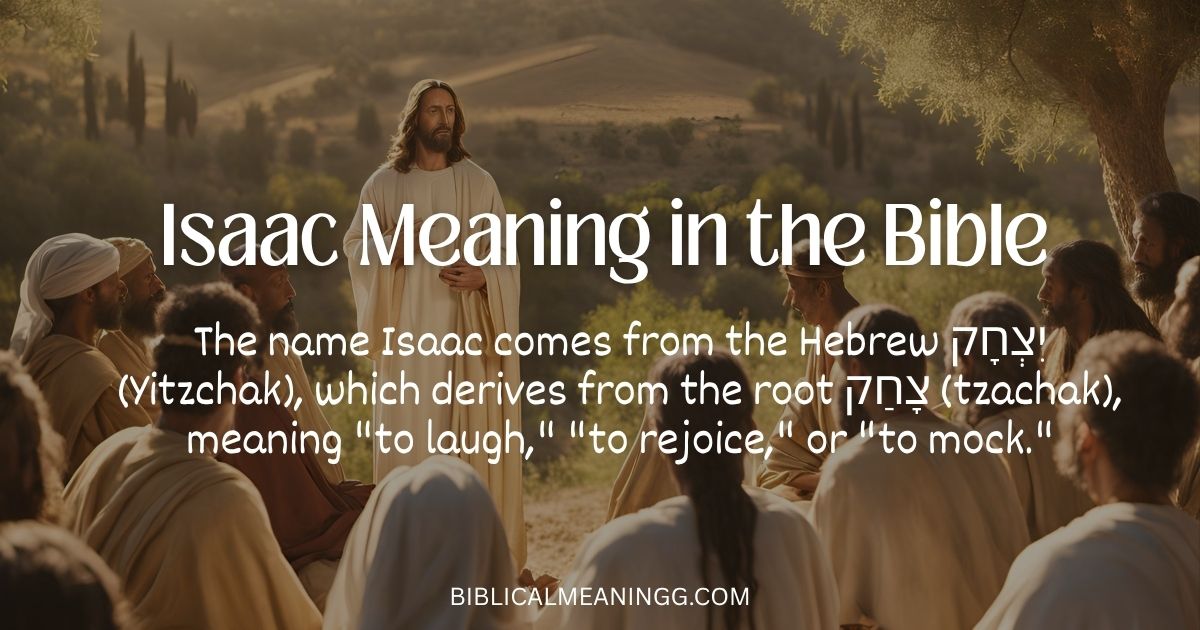
The name Isaac comes from the Hebrew יִצְחָק (Yitzchak), which derives from the root צָחַק (tzachak), meaning “to laugh,” “to rejoice,” or “to mock.”
But here’s what most articles miss: there are three separate moments of laughter in Genesis tied to Isaac’s name, and each one carries a different emotional register. Abraham laughed. Sarah laughed. And after Isaac was born, Sarah declared that everyone who heard would laugh with her.
Three laughs. Three meanings. One name that encompasses the full arc of human doubt, divine humor, and ultimate joy.
Define Isaac: The Hebrew Root and Its Spiritual Weight
Isaac definition: A masculine given name of Hebrew origin meaning “he laughs,” “he will laugh,” or “laughter.”
In biblical Hebrew, the verb tzachak (צָחַק) carries a spectrum of meaning:
- Laughter of disbelief, the laugh of someone hearing the impossible
- Laughter of mockery, Ishmael “laughing at” Isaac (Genesis 21:9)
- Laughter of joy, Sarah’s declaration in Genesis 21:6
- Playful delight, used in Genesis 26:8 when Isaac is “caressing” Rebekah
This single root word appears across Isaac’s entire life narrative. His very existence was laughed at before it happened. His name memorialized the laughter. And his life generated more laughter, both bitter and joyful. That’s not coincidence. That’s literary and theological craftsmanship.
Isaac Name Meaning: A Linguistic Breakdown
| Hebrew Form | Transliteration | Meaning |
|---|---|---|
| יִצְחָק | Yitzchak | “He laughs” / “He will laugh” |
| צָחַק | tzachak (root verb) | To laugh, to play, to mock |
| צְחוֹק | tzchok (noun form) | Laughter |
| יִצְחַק (imperfect form) | yitzchak | “He will laugh” (future tense) |
The name is grammatically in the imperfect (future) tense, which is deeply significant. Isaac’s name doesn’t just record past laughter. It anticipates future laughter. It’s forward-looking.
God named him before his birth (Genesis 17:19). That future-tense name was a prophetic declaration: what seemed impossible will bring joy you haven’t experienced yet.
What Does Isaac Mean in Genesis? Understanding the Three Laughs
Laugh 1: Abraham’s Laughter (Genesis 17:17)
“Abraham fell facedown; he laughed and said to himself, ‘Will a son be born to a man a hundred years old? Will Sarah bear a child at the age of ninety?'”
Abraham’s laugh here is complex. It’s not mocking God. It’s the involuntary response of a man whose brain cannot process what his faith is being asked to hold. He’s 99. Sarah is 89. The biology is impossible.
Jewish scholars like Rashi interpret this as a laugh of joy and astonishment, not skepticism. Abraham immediately follows it by requesting that Ishmael receive God’s blessing, suggesting he accepts the promise, he just can’t quite believe it yet.
This is the laugh of stretching faith, when your mind protests what your spirit is being invited to trust.
Laugh 2: Sarah’s Laughter (Genesis 18:12-15)
“So Sarah laughed to herself as she thought, ‘After I am worn out and my lord is old, will I now have this pleasure?'”
Sarah’s laugh is different. It’s private. It happens inside the tent while three heavenly visitors are speaking to Abraham. She hears the promise and laughs to herself, quietly, almost bitterly.
When confronted, she denies laughing. She’s afraid. This tells you something honest about Sarah: her laugh was touched with shame or doubt, something she wasn’t proud of.
Yet God didn’t punish her for it. He simply asked: “Is anything too hard for the Lord?” (Genesis 18:14)
This question, the rhetorical heart of the Isaac narrative, became a cornerstone of biblical theology. It appears again in Jeremiah 32:27. It echoes in the angel Gabriel’s words to Mary in Luke 1:37. Isaac’s story planted this question so deeply in Scripture that it keeps resurfacing whenever the impossible meets the faithful.
Laugh 3: Sarah’s Laughter After Birth (Genesis 21:6-7)
“Sarah said, ‘God has brought me laughter, and everyone who hears about this will laugh with me.'”
This laugh is pure joy. The doubt is gone. The baby is here. And Sarah’s laughter transforms from something private and ashamed into something communal and celebratory.
Notice the shift: in Genesis 18, she laughed to herself and denied it. In Genesis 21, she announces her laughter and invites the world to share it.
That’s the arc of faith. What you once laughed at alone in doubt, you eventually proclaim out loud in joy.
Isaac in the Bible: His Full Narrative Role
Isaac is one of the three patriarchs of Israel, Abraham, Isaac, and Jacob, and his story spans Genesis 17 through 35. Yet compared to Abraham’s epic journey and Jacob’s dramatic transformation, Isaac’s life seems quieter. More domestic. Less eventful. This is intentional.
Isaac as the “Bridge” Patriarch
Isaac functions as a covenant bridge, the living connection between Abraham’s founding promise and Jacob’s twelve tribes. He doesn’t originate the covenant (Abraham did) and doesn’t multiply it dramatically (Jacob did). He preserves it.
In a culture that prized heroic action, Isaac is the man who:
- Submits on the altar at Moriah (Genesis 22)
- Meditates in the field at evening (Genesis 24:63)
- Digs wells when driven out by enemies (Genesis 26)
- Blesses his sons even when deceived (Genesis 27)
His life is a theology of faithful endurance over dramatic conquest. He’s the patriarch of the ordinary, and that’s a far more subversive spiritual statement than it first appears.
This same quiet pattern of faithfulness through suffering is at the heart of Job in Bible. Both Isaac and Job teach us that endurance without spectacle is its own kind of holy greatness.
The Binding of Isaac: What Akedat Yitzchak Really Means
Genesis 22, the near-sacrifice of Isaac, is called in Jewish tradition the Akedah (עֲקֵידָה, “the binding”). It is arguably the most theologically dense passage in all of Genesis.
What’s often overlooked: Isaac is not a small child here. Jewish and many Christian scholars estimate he was between 25 and 37 years old based on textual evidence. He could have resisted. He chose not to.
This transforms the Akedah from a story about a father’s obedience to a story about two people surrendering to God simultaneously, father and son, both laying down their will.
This foreshadowing is unmistakable to Christian readers: a beloved son, willingly submitted, on a mountain in the land of Moriah, the same region later identified with Jerusalem (2 Chronicles 3:1). The theological echoes are deliberate and profound.
The act of consecrating Isaac on that altar connects directly to what Biblical consecration meaning. Isaac’s body on that altar was the most literal act of consecration in all of Genesis.
Isaac’s Meaning Across Four Dimensions
1. Historical Meaning
In the ancient Near East, names were not decorative. They were identity statements. For Abraham and Sarah to name their child “laughter” was to permanently inscribe the memory of God’s impossible promise into every conversation.
Every time someone called Isaac’s name, they were, in effect, recalling the miracle of his birth. His name was a walking testimony.
In the historical context of the Ancient Near East, where child mortality was high and barrenness carried social stigma, Isaac represented something unprecedented: a child of promise given to people beyond biological hope. He wasn’t just born. He was delivered into existence by divine intervention.
2. Biblical and Theological Meaning
Isaac’s name appears over 130 times in the Old Testament. He’s named in the covenant formula, “the God of Abraham, Isaac, and Jacob,” which appears repeatedly in Scripture and remains the most common way God identifies Himself to Israel.
Theologically, Isaac represents:
- The impossible made real, God’s power over biology and time
- The covenant’s continuity, the link between promise and fulfillment
- The pattern of sacrifice and redemption, prefiguring the cross
3. Spiritual and Personal Meaning
On a personal spiritual level, Isaac’s name speaks directly to anyone who has faced a promise delayed so long it seemed laughable.
Have you ever felt like your dream, your healing, your breakthrough was so overdue that you’d almost given up? Abraham was 100. Sarah was 90. They had already tried their own solution (Ishmael) and it created more problems than it solved.
Isaac’s birth says something to that person: the laughter will come, but it will be God’s laughter, not yours. And when it comes, you won’t be able to contain it.
This kind of patient waiting requires what the Bible calls meekness, not weakness but strength surrendered to God’s timing. Meekness in Bible. Abraham and Sarah practiced this meekness across 25 years of waiting.
4. Prophetic and Symbolic Meaning
The Apostle Paul interprets Isaac prophetically in Galatians 4:21-31, using him to symbolize children of the Spirit, those born of divine promise rather than human effort. Ishmael represents the flesh; Isaac represents grace.
This is not an allegory Paul invented. It’s embedded in the very name. Laughter, spontaneous, unexpected, unearned, is grace. You can’t manufacture laughter. It rises from joy you didn’t plan. That’s the nature of the gospel, Paul argues: it cannot be earned through effort (Ishmael), only received through promise (Isaac).
Key Bible Verses About Isaac: With Context
Genesis 17:19: The Name Before the Birth
“Then God said, ‘Yes, but your wife Sarah will bear you a son, and you will call him Isaac. I will establish my covenant with him as an everlasting covenant for his descendants after him.'”
Context: God is speaking directly to Abraham, who has just suggested that Ishmael could be the heir. God’s response is direct and gracious: No, it’s Sarah’s son. And I’ve already chosen his name. This is remarkable. God doesn’t wait for the child to arrive to assign meaning. He names him before conception is even possible. The name Isaac is God’s declaration of intent.
Genesis 21:6: Laughter Fulfilled
“Sarah said, ‘God has brought me laughter, and everyone who hears about this will laugh with me.'”
Context: The word Sarah uses for “brought me laughter,” tzchok, is the same root as Isaac’s name. She’s essentially saying: God has given me an Isaac moment, a laughter I didn’t plan, couldn’t produce, and can’t contain. This verse is the emotional climax of Isaac’s birth narrative.
Genesis 22:2: The Ultimate Test
“Then God said, ‘Take your son, your only son, whom you love, Isaac, and go to the region of Moriah.'”
Context: Notice how God layers the description: your son, your only son, whom you love, Isaac. Four identifiers. God knows exactly what He is asking. This isn’t cruelty. It’s the shaping of a man’s deepest attachment. The ram appears in verse 13. But the theological point is already made: what you love most must be held open-handed before God.
Romans 9:7: Isaac in New Testament Theology
“It is through Isaac that your offspring will be reckoned.”
Context: Paul uses Isaac to explain that spiritual lineage is not biological. Isaac represents the principle of election through grace, God chooses based on His sovereign promise, not human genealogy.
Isaac and the Other Patriarchs: Comparison Table
| Patriarch | Name Meaning | Primary Theme | Key Trial | Covenant Role |
|---|---|---|---|---|
| Abraham | “Father of many nations” | Pioneer Faith | Leaving homeland; Moriah | Founder of covenant |
| Isaac | “He laughs / Laughter” | Faithful Endurance | The Akedah (binding) | Preserver of covenant |
| Jacob | “Supplanter / He grasps the heel” | Transformation | Wrestling with God | Multiplier of covenant |
| Joseph | “God will add / increase” | Redemptive Suffering | Slavery, prison | Deliverer of covenant people |
Isaac and Sarah: The Spiritual Power of Barrenness Reversed
Sarah’s barrenness (aqarah in Hebrew, עֲקָרָה) is one of the Bible’s most recurring motifs. Rebekah, Rachel, Hannah, Elizabeth: the pattern repeats deliberately.
Why does God so often work through the barren womb? Because barrenness removes all human explanation from the miracle. When a young, healthy woman conceives, biology gets the credit. When a 90-year-old woman conceives, only God gets the credit.
Isaac’s birth was engineered to be undeniable. And his name, laughter, is the human response to experiencing something so impossible it bypasses rational processing and goes straight to involuntary joy.
This is why Isaac’s story is theologically foundational. It establishes a pattern: God often works precisely where human resources are exhausted, so that faith has no competition from self-sufficiency.
Isaac and the Book of Genesis: Entity Relationships
Understanding Isaac requires understanding his relational web within Genesis:
Abraham is Isaac’s father, the man whose faith is credited as righteousness (Genesis 15:6). Isaac inherits both the promise and the faith template.
Sarah is Isaac’s mother. Her laughter arc (doubt, denial, joy) mirrors the spiritual journey many believers walk. She’s the first woman explicitly named in the covenant.
Rebekah is Isaac’s wife, chosen through divine providence (Genesis 24). Genesis 24:67 says Isaac loved Rebekah, one of the earliest explicit mentions of romantic love in Scripture.
Jacob and Esau are Isaac’s twin sons. The birthright conflict between them sets the stage for all twelve tribes of Israel. Isaac’s blessing of Jacob (even when deceived) becomes irrevocable, a statement about how covenantal blessings work.
Ishmael is Isaac’s half-brother. Their relationship represents the tension between human striving and divine promise that runs through all of Genesis.
The Covenant (brit, בְּרִית in Hebrew) is God’s formal promise to Abraham, renewed with Isaac in Genesis 26:3-5. He doesn’t merely inherit Abraham’s wealth. He inherits Abraham’s promise.
What Does Isaac Mean Spiritually? A Modern Reading
If Isaac’s name means “laughter,” then his life is a spiritual argument for this truth: joy is not the absence of pain. It’s what breaks through on the other side of impossible faith.
Abraham and Sarah didn’t live in cheerful optimism for 25 years while waiting for Isaac. They navigated impatience (Genesis 16), doubt (Genesis 18), and fear (Genesis 20). They tried their own solution and watched it create family conflict. They were human in every embarrassing way.
And then, laughter.
There’s something deeply pastoral about this. The biblical narrative doesn’t ask you to pretend the waiting isn’t hard. It just shows you that the laughter, when it comes, is worth every year of the wait.
Sometimes the hardest part of waiting is knowing when to stop striving and simply trust. Ceasing in Bible. Abraham and Sarah’s greatest mistake (Hagar and Ishmael) came from refusing to cease. Their greatest miracle (Isaac) came when they finally did.
Isaac in Other Biblical Books
Exodus 3:6 places him at the center of God’s self-identification to Moses: “I am the God of Abraham, the God of Isaac, and the God of Jacob.” This formula grounds the Exodus liberation in covenant memory.
Psalm 105:9 cites the covenant with Abraham “which he confirmed to Isaac” as the reason God protected Israel throughout history.
Matthew 8:11 records Jesus saying that many will come from east and west to sit at table with Abraham, Isaac, and Jacob in the kingdom of heaven.
Hebrews 11:17-20 places Isaac in the Hall of Faith, honored both as the one offered and the one who blessed his sons by faith.
James 2:21 identifies Abraham as righteous by works when he offered Isaac, the Akedah as the ultimate expression of faith that acts.
Names carry theological weight throughout all of Scripture. Just as Isaac’s name encodes a divine promise, Ian in Bible. Every name in the biblical world was a window into something eternal.
Reader Exercise: The “Impossible Laughter” Reflection
Before you reach the conclusion, sit with this for a moment.
Think of one promise, from God, from Scripture, from a deep sense of calling, that you’ve been waiting for so long it has started to feel embarrassing. Something you’ve almost stopped mentioning because you’re tired of explaining why it hasn’t happened yet.
Step 1: Write it down. Even if it feels foolish.
Step 2: Write next to it: “Is anything too hard for the Lord?” (Genesis 18:14)
Step 3: Write the name Isaac beside it. Remember what it means: He will laugh. Future tense. Not yet. But certain.
Isaac’s name was spoken into existence before Isaac existed. The laughter was named before the laughter was experienced. What if God has already named what you’re waiting for, and you’re still in the chapter before the birth?
Don’t rush to close the book.
FAQ: Isaac Meaning in the Bible
What does the name Isaac mean spiritually?
Spiritually, Isaac’s name represents the intersection of human impossibility and divine certainty. The laughter encoded in his name isn’t frivolity. It’s the involuntary response of encountering the supernatural. Isaac represents the principle that God’s promises don’t expire, even when human biology, logic, or time says otherwise. His name is a constant reminder that joy is the destination of genuine faith, even when the journey looks absurd.
What is the Hebrew meaning of Isaac?
The Hebrew name Yitzchak (יִצְחָק) comes from the root tzachak (צָחַק), meaning to laugh, to rejoice, or in some contexts, to mock or play. It is grammatically in the future imperfect tense, meaning “he will laugh,” making it forward-looking rather than simply commemorative. God assigned this name, suggesting that the future joy of Isaac’s existence was certain before it was humanly conceivable.
Why is Isaac important in the Bible?
Isaac’s importance is threefold. First, he is the fulfillment of God’s core promise to Abraham, the child through whom all nations would be blessed (Genesis 12:3, 22:18). Second, he is the covenant link between Abraham and Jacob, ensuring the unbroken chain of God’s redemptive plan. Third, his near-sacrifice in Genesis 22 establishes a prophetic pattern, the willing son on the mountain, that the New Testament explicitly connects to Jesus Christ.
Why did God name Isaac before he was born?
God naming Isaac before conception (Genesis 17:19) was a deliberate act of divine authority. In the ancient world, naming was an act of ownership and identity-formation. By naming Isaac in advance, God was asserting: this child belongs to My plan, not to biological probability. The name also locked in the memory of Abraham and Sarah’s laughter, preserving their humanity and God’s faithfulness simultaneously.
What is the significance of the three laughs in Isaac’s story?
Abraham’s laugh (Genesis 17:17) represents faith being stretched beyond comfort. Sarah’s laugh (Genesis 18:12) represents private doubt. Sarah’s post-birth declaration (Genesis 21:6) represents communal joy. Together, these three laughs trace the full arc of walking with God through the impossible. Just as Grand Rising meaning, Isaac’s three-laugh arc is a narrative of rising from doubt into dawn.
How is Isaac connected to Jesus in the New Testament?
The connections are extensive and intentional. Both were children of divine promise. Both were “only sons” given up by their fathers. Both carried the wood of their sacrifice. Both went to the same geographic region, Moriah/Jerusalem. Isaac’s story resolves with a substitutionary ram; Jesus’s story resolves with no substitute. He is the substitution. Hebrews 11:19 says Abraham believed God could raise Isaac from the dead, “and in a manner of speaking he did receive Isaac back from death.” This is explicit typology.
What does Isaac’s life teach about suffering and faith?
Isaac’s life is a masterclass in quiet faithfulness. He is driven out by Philistines and instead of fighting, he digs new wells (Genesis 26:12-22). Every time they fill his wells, he moves and digs again. He doesn’t rage. He perseveres. The Philistines eventually come to him seeking peace (Genesis 26:26-29). His life teaches that patient, consistent faithfulness is its own kind of spiritual power.
Is the name Isaac used symbolically in Paul’s letters?
Yes. In Galatians 4:21-31, Paul uses Isaac and Ishmael as allegories for two ways of receiving God’s blessing, through human effort (Ishmael/Hagar/law) versus through divine promise (Isaac/Sarah/grace). Paul calls believers “children of promise, like Isaac” (Galatians 4:28). In Romans 9:7-9, Isaac again represents the principle that God’s election works through promise, not biology or human striving. This connects to what Samuel’s calling.
Conclusion: The Name That Keeps Laughing
Isaac’s name is not a relic of ancient biography. It’s a living theological statement.
Every time the God of Abraham, Isaac, and Jacob is invoked, in synagogue, in church, in personal prayer, the name of laughter echoes. It says: the impossible happened here. It can happen again.
Sarah laughed in doubt. Then she laughed in joy. And she invited the whole world to laugh with her.
That’s the invitation Isaac’s name still extends to every person who has a promise that feels overdue, a prayer that has gone too long unanswered, a dream that has started to feel embarrassing in its persistence.
His name is future-tense for a reason. He will laugh. Not “he laughed.” Not past tense. Not merely commemorative.
Forward-looking. Promise-anchored. Impossible-expecting.
Is anything too hard for the Lord?
For more deep dives into biblical names and their spiritual significance, discover Emma in Bible, explore Name Phoenix meaning, or read about Biblical meekness.