Number 18 Meaning in the Bible: Struggle, Freedom and Renewal
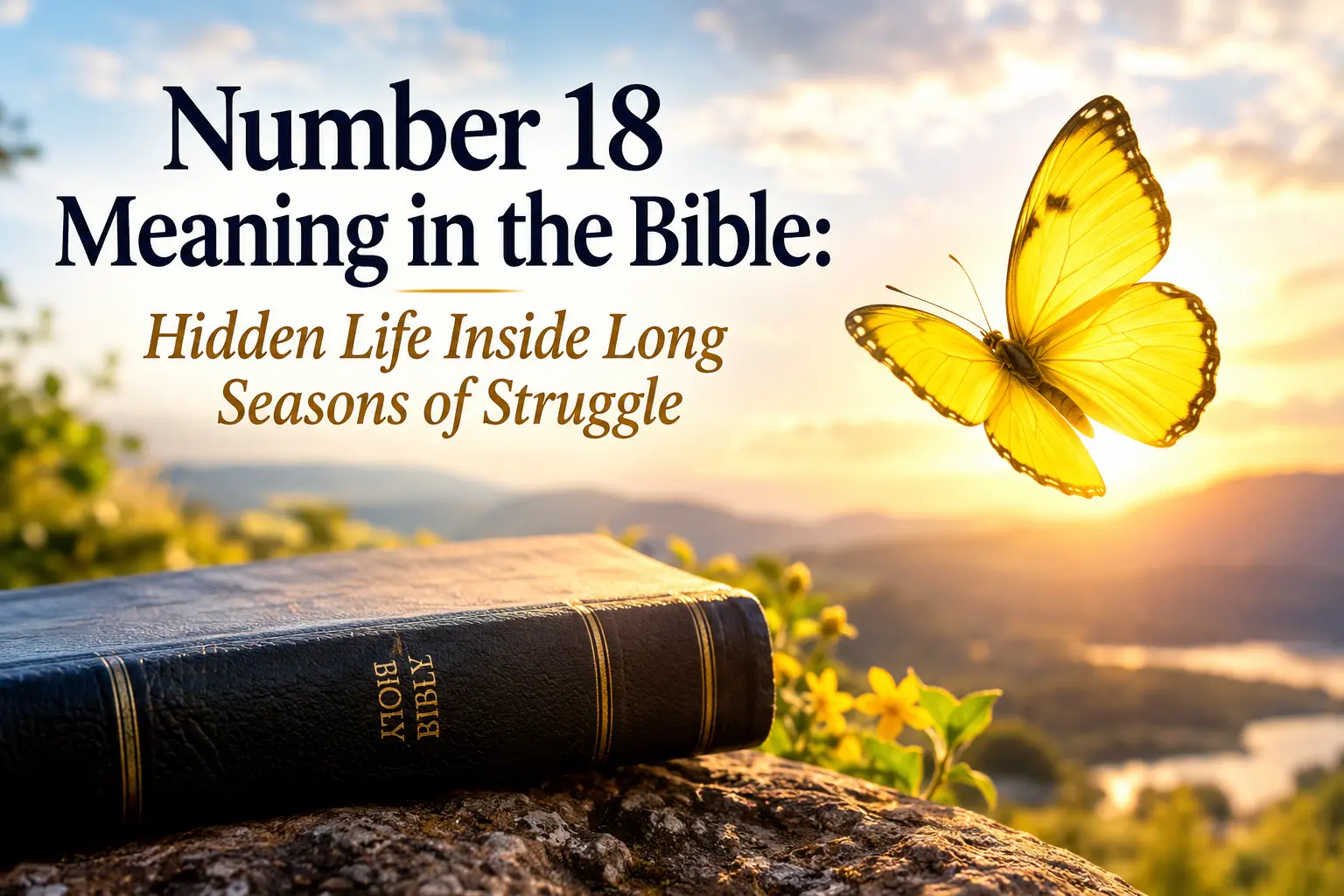
The number 18 meaning in the Bible is interesting because Scripture does not give the number a single official symbolic definition. Instead, its significance comes from the passages where the number appears.
Two especially notable examples occur in Luke 13. Jesus spoke about 18 people who died when the tower of Siloam fell, and He later healed a woman who had suffered for 18 years. Another important reference appears in Judges 3, where the Israelites were oppressed by the Moabites for 18 years before God brought deliverance through Ehud.
Because of these passages, some readers connect 18 with long periods of suffering, oppression, repentance, deliverance, healing, and restoration.
However, it is important to distinguish biblical interpretation from numerology. The Bible never says that every appearance of 18 carries a hidden message or that seeing 18 repeatedly predicts a particular event.
The most meaningful way to understand this number is to study the biblical stories in which it appears.
What Does the Number 18 Mean in the Bible?
The Bible does not directly state, “The number 18 means suffering” or “18 means freedom.”
Instead, several significant passages involving 18 contain themes of hardship, mortality, repentance, healing, and deliverance.
The most important examples include:
- 18 years of oppression in Judges 3:14
- 18 years of physical suffering in Luke 13:11
- 18 people who died when the tower of Siloam fell in Luke 13:4
These passages occur in different contexts, so they should not be treated as if they all have exactly the same meaning.
Still, a noticeable theme appears in some of them: human suffering is real, but it is not necessarily the end of the story.
In Judges, oppression eventually ends. In Luke 13, a woman who had suffered for 18 years is healed by Jesus.
For this reason, Christians sometimes reflect on 18 as a reminder of enduring hardship and the hope of God’s intervention.
That is an interpretation based on biblical narratives, not a direct biblical definition of the number.
Where Does the Number 18 Appear in the Bible?
Several passages mention the number 18, but three are particularly useful when exploring its biblical context.
See Also: Hunnnah Meaning in Bible: Meaning, Origin & Significance
The Woman Bound for 18 Years
One of the most memorable references appears in Luke 13:10–17.
Jesus was teaching in a synagogue on the Sabbath when He saw a woman who had been suffering from a disabling condition for 18 years.
Jesus called her forward and told her that she was released from her infirmity. He placed His hands on her, and she immediately became physically upright and glorified God.
The passage is powerful because the woman had endured her condition for a very long time.
Her story moves from:
18 years of suffering → encounter with Jesus → healing → praise
The emphasis of the passage is not that 18 is a magical number. The focus is on Jesus’ compassion, authority, healing, and restoration.
The People Killed by the Tower of Siloam
Another reference appears earlier in Luke 13.
Jesus mentioned 18 people who died when the tower of Siloam fell on them.
Some people apparently connected the tragedy with the victims’ supposed guilt. Jesus challenged that assumption.
His point was that the victims were not necessarily worse sinners than everyone else simply because they experienced this tragedy.
Jesus then used the event to teach about repentance.
This passage is important because it prevents us from giving 18 one simplistic interpretation.
In one part of Luke 13, 18 is associated with a tragic loss of life. Later in the same chapter, 18 years describes a woman’s suffering before she is healed.
The surrounding context matters more than the number by itself.
Israel’s 18 Years Under Oppression
Another important reference appears in Judges 3:12–30.
Israel again did what was evil in the sight of the Lord, and God allowed Eglon, king of Moab, to gain power over Israel.
The Israelites were oppressed for 18 years.
Eventually, the Israelites cried out to the Lord. God raised up Ehud as a deliverer. Ehud confronted Eglon, and Israel was eventually freed from Moabite oppression.
The story contains a pattern that readers may find spiritually meaningful:
disobedience → oppression → crying out → deliverance → peace
The 18-year period represents a prolonged season of oppression within that specific story.
It does not mean that every difficult period lasting 18 years has the same spiritual explanation.
The Biblical Theme Behind 18: A Long Season of Struggle
One reason the number 18 attracts attention is that two biblical stories associate it with extended suffering.
The woman in Luke 13 had endured her condition for 18 years.
Israel endured Moabite oppression for 18 years.
Both accounts involve a long period that eventually changes.
This can make 18 a meaningful number for personal reflection, especially for someone who feels trapped in a difficult season.
1. Prolonged Oppression
Judges 3 presents 18 years of oppression under Moabite rule.
The length of the period emphasizes that Israel’s difficulty was not brief. The people lived under oppression for years before the situation changed.
For modern readers, this can be a reminder that some struggles are longer than expected.
The Bible does not promise that every difficult situation will end according to our preferred timeline. But these stories show that a long period of hardship does not automatically mean that God has abandoned His people.
2. A Burden That Seems to Continue
The woman in Luke 13 had suffered for 18 years.
Imagine carrying the same physical burden year after year. Her story gives a human face to long-term suffering.
The Bible does not describe her as forgotten.
Jesus noticed her.
That detail is central to the story.
Her healing reminds readers that a person’s circumstances may be invisible to others while still being fully known by God.
3. God’s Intervention
Both Judges 3 and Luke 13 contain a major change after a long period of difficulty.
In Judges, God raises up Ehud as a deliverer.
In Luke, Jesus directly heals the woman.
The circumstances are very different, but both stories contain a movement from hardship toward freedom.
This is one reason some Christians associate the number 18 with hope after a prolonged struggle.
Again, this is an interpretation drawn from the narratives rather than a definition explicitly stated in Scripture.
4. Freedom and Restoration
The woman in Luke 13 did not simply receive physical relief.
She stood upright and began glorifying God.
Her healing restored something visible and personal to her life.
The story also shows Jesus defending her dignity when the synagogue ruler objected to the healing because it occurred on the Sabbath.
The passage therefore includes several themes:
- healing
- freedom
- dignity
- compassion
- restoration
- worship
These themes are more important than treating 18 as a mystical code.
Number 18 and the Theme of Freedom in Scripture
When studying the number 18, freedom is one of the strongest themes that can reasonably be drawn from the biblical narratives.
The Israelites were eventually released from Moabite oppression.
The woman in Luke 13 was released from her long-term affliction.
In both cases, the idea of release follows a prolonged period of difficulty.
From Bondage to Release
The story in Judges shows Israel living under foreign oppression.
After the Israelites cried out to God, deliverance came through Ehud.
The story belongs to the larger cycle found throughout Judges, where Israel repeatedly falls into disobedience, experiences oppression, cries out, and receives a deliverer.
The important lesson is not that 18 itself causes freedom.
Rather, the biblical story demonstrates God’s ability to bring His people through periods of oppression.
Freedom Is the Stronger Message Than the Number
This distinction is important.
If someone sees the number 18 repeatedly, it may be tempting to search for a secret prediction.
But the Bible itself directs attention toward God, repentance, faith, obedience, compassion, and restoration.
The number should never become more important than the passage in which it appears.
For Christians, the story of the woman in Luke 13 is ultimately about Jesus’ compassion and authority, not about decoding the number 18.
Is 18 a Symbol of Struggle in the Bible?
It can be interpreted as a number associated with prolonged struggle in certain biblical passages, but Scripture does not establish 18 as a universal symbol of struggle.
The connection comes mainly from:
- Israel’s 18 years of oppression in Judges 3
- the woman’s 18 years of suffering in Luke 13
These are genuine biblical associations.
However, other references to 18 have different contexts.
This is why it would be misleading to say that “18 always means struggle.”
Biblical numbers need to be understood within their surrounding passages.
Is the Number 18 a Sign of Deliverance?
Some Christians interpret 18 as connected with deliverance because two important narratives involving the number eventually move toward freedom.
In Judges 3, Israel’s oppression ends after God raises up Ehud.
In Luke 13, the woman is released from her long-standing condition when Jesus heals her.
But the Bible does not teach that seeing 18 means that deliverance is guaranteed or that a particular event will happen soon.
A better spiritual takeaway is this:
Long seasons of difficulty do not prevent God from bringing change, healing, or restoration.
That is a biblical message supported by the stories themselves.
Number 18 and Repentance in Luke 13
Luke 13 is especially interesting because Jesus mentions the number 18 twice in the same chapter.
First, He refers to the 18 people who died when the tower of Siloam fell.
Then He encounters a woman who had suffered for 18 years.
At first glance, these two references might appear unrelated.
But both are connected to important teachings from Jesus.
The Tower of Siloam
Jesus used the tragedy to challenge the idea that suffering automatically proves someone’s greater sinfulness.
He directed His listeners toward repentance instead.
The lesson is significant because people naturally try to explain tragedy by assigning blame.
Jesus did not encourage that approach.
The Woman Who Suffered for 18 Years
Later in the chapter, Jesus encounters the woman whose condition had lasted 18 years.
He heals her and publicly challenges the criticism directed toward the healing.
Together, these passages show that Luke 13 is not giving readers a secret numerical formula.
Instead, the chapter addresses:
- repentance
- suffering
- mortality
- compassion
- healing
- God’s kingdom
- restoration
The number 18 appears within those teachings, but it does not control their meaning.
What Does 18 Mean Spiritually for Christians?
A Christian may use biblical references to 18 as a point of reflection during difficult seasons.
The following applications stay closer to the biblical stories.
When You Have Been Waiting for a Long Time
The woman in Luke 13 had lived with her condition for 18 years.
Her story can encourage someone who feels that a difficult situation has continued for far too long.
Waiting can be exhausting.
But the passage reminds readers that the length of a struggle does not determine a person’s worth or whether God sees them.
When You Feel Trapped by Circumstances
The woman was described as unable to straighten herself fully.
Her situation had continued for years.
Her encounter with Jesus changed her circumstances dramatically.
For a Christian facing a difficult situation, this can become a reminder to bring burdens to God rather than assuming that a long struggle has no purpose or possible change.
When You Are Going Through a Difficult Season
The Israelites experienced 18 years of oppression before their situation changed.
Their story highlights the importance of turning toward God during hardship.
This does not mean that every hardship has a simple explanation.
It means that biblical stories repeatedly encourage people to seek God during difficult circumstances.
See Also: Hesed Meaning in the Bible: The Deepest Form of God’s Love
When You Need to Remember That Life Is Uncertain
The 18 people who died at Siloam remind readers that life can change unexpectedly.
Jesus used the tragedy to teach about repentance.
The passage therefore encourages people not to postpone spiritual matters indefinitely.
When Freedom Finally Comes
The woman who was healed responded by glorifying God.
Her response provides an important lesson.
Restoration can lead to gratitude.
When circumstances improve, Christians can recognize the good they have received rather than focusing only on the difficulty that came before it.
What Should You Do If You Keep Seeing the Number 18?
If you repeatedly notice 18 on clocks, receipts, addresses, dates, or other places, you do not need to assume that the number automatically contains a supernatural prediction.
Instead, you can use the experience as a reminder to turn toward biblical principles.
Consider these steps:
- Pray and ask God for wisdom.
- Read the relevant biblical passages, especially Judges 3 and Luke 13.
- Reflect on your circumstances honestly.
- Look for practical steps you can take rather than waiting for a number to give you instructions.
- Practice patience when circumstances cannot be changed immediately.
- Seek wise counsel from trustworthy people when you need guidance.
- Give thanks for the ways you have experienced help, growth, or restoration.
Most importantly, do not allow a number to replace Scripture.
The Bible’s message is much broader and deeper than numerical patterns.
Number 18 vs. Other Biblical Numbers
Numbers appear throughout Scripture, and some have recurring patterns that have attracted theological attention.
| Number | Common Biblical Associations | Important Note |
|---|---|---|
| 3 | Appears in several significant biblical patterns | Meaning depends on context |
| 7 | Often associated with completion or fullness | Not every occurrence is symbolic |
| 12 | Frequently connected with God’s people | Seen in the tribes of Israel and apostles |
| 18 | Appears in passages involving oppression, suffering, death, healing, and deliverance | No single explicit definition |
| 40 | Frequently appears in periods of testing, preparation, or transition | Context still matters |
The key principle is simple: not every number in the Bible is a hidden symbol.
Some numbers are simply used to describe quantities, ages, measurements, or periods of time.
What Number 18 Does Not Mean in the Bible
It is equally important to understand what Scripture does not say about 18.
The Bible does not explicitly teach that:
- 18 guarantees financial blessings.
- 18 guarantees marriage or a relationship.
- 18 predicts a specific future event.
- Seeing 18 means a breakthrough is definitely coming.
- Repeatedly seeing 18 proves that God is sending a numerical message.
- Every biblical occurrence of 18 has the same symbolic meaning.
- 18 is inherently lucky or unlucky.
These ideas may appear in modern spiritual or numerological discussions, but they should not be presented as direct biblical teaching.
A careful Christian interpretation should begin with Scripture itself.
Lessons We Can Learn From the Biblical References to 18
Although the Bible does not assign one official meaning to 18, its notable appearances can point readers toward several important lessons.
God Sees Long-Term Suffering
The woman in Luke 13 had suffered for 18 years.
Her story shows that long-term suffering does not make a person invisible to God.
Oppression Does Not Last Forever
Israel’s 18-year oppression eventually ended.
The story shows that circumstances can change, even after an extended period of difficulty.
Suffering Should Not Automatically Be Interpreted as Punishment
Jesus’ teaching about the tower of Siloam challenges simplistic assumptions about why tragedy happens.
A person’s suffering should not automatically be treated as proof of personal guilt.
God’s Intervention Can Bring Restoration
The woman in Luke 13 experienced a dramatic change after encountering Jesus.
Her story places compassion and restoration at the center.
Repentance Matters
Jesus connected the discussion surrounding the tower of Siloam with a call to repentance.
The passage therefore directs attention away from judging victims and toward examining one’s own life.
Gratitude Should Follow Restoration
After being healed, the woman glorified God.
Her response shows the natural connection between receiving mercy and responding with gratitude.
Frequently Asked Questions About Number 18 in the Bible
What is the biblical meaning of number 18?
The Bible does not give 18 one official meaning. However, important references connect the number with prolonged oppression, suffering, mortality, healing, repentance, and eventual freedom.
What happened after 18 years in the Bible?
In Judges 3, Israel was oppressed for 18 years before God raised up Ehud as a deliverer. In Luke 13, Jesus healed a woman who had suffered for 18 years.
Is 18 a lucky number in Christianity?
Christianity does not teach that 18 is a lucky or unlucky number. Biblical numbers should be understood within their specific passages rather than treated as good-luck or bad-luck signs.
Is 18 a symbol of deliverance?
Some readers associate 18 with deliverance because certain biblical stories involving 18 end with release from oppression or suffering. However, Scripture does not explicitly define 18 as a symbol of deliverance.
What does Luke 13 say about 18?
Luke 13 mentions 18 people who died when the tower of Siloam fell and later describes a woman who had suffered for 18 years before Jesus healed her. The two passages have different contexts.
Why is the number 18 important in the Bible?
Its importance comes from the biblical events in which it appears. The most notable references involve 18 years of oppression, 18 years of suffering, and the 18 people who died at Siloam.
Does seeing 18 repeatedly have a biblical meaning?
The Bible does not say that repeatedly seeing a number proves God is sending a specific message. Christians can use such moments for personal reflection, but should not treat them as guaranteed predictions.
What should Christians do when they see repeating numbers?
Christians can pray, read Scripture, seek wisdom, examine their circumstances, and make practical decisions based on biblical principles rather than assuming that a repeating number provides a specific prediction.
Final Thoughts on the Number 18 in the Bible
The number 18 meaning in the Bible is best understood through the passages where it appears rather than through a single formula.
In Judges, 18 years describes Israel’s prolonged oppression before deliverance. In Luke 13, 18 years describes a woman’s long suffering before Jesus heals her. The same chapter also mentions 18 people who died in a tragic accident, leading Jesus to teach about repentance rather than blame.
These passages give readers several meaningful themes to consider: long seasons of hardship, compassion, repentance, healing, freedom, and restoration.
But the Bible never says that 18 itself guarantees a particular outcome.
The deeper lesson is found in the stories surrounding the number. When life feels prolonged, uncertain, or difficult, Scripture encourages people to seek God, remain attentive to His teaching, practice wisdom, and remember that a long season does not necessarily define the rest of the story.
The number may catch your attention, but the biblical message behind the passage is what deserves your attention most.